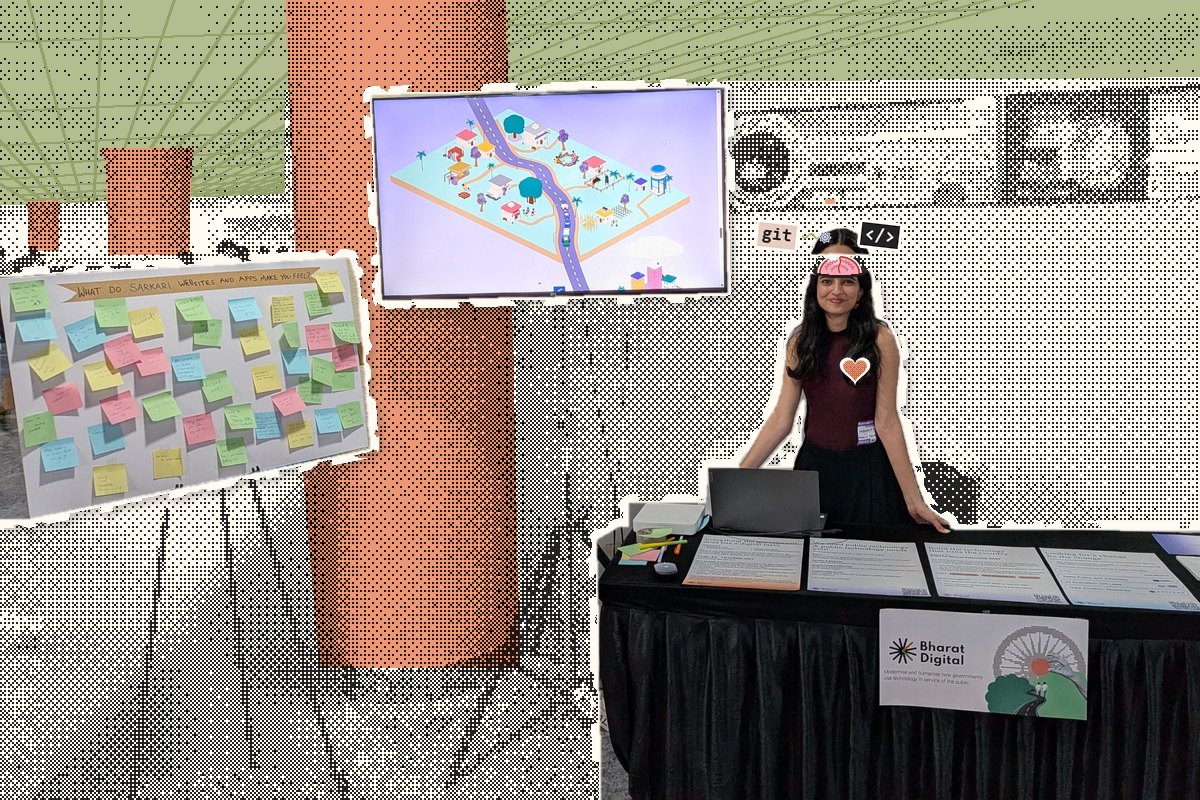
“So, what do you do?”, asked a voice out of left field. I was at the 6th edition of India’s largest Free and Open Source Software (FOSS) festival, IndiaFOSS 2026, with 2.5 feet of table between me and the voice. My position relative to the table meant that I was supposed to have all the answers. Especially to a seemingly innocuous question like “What do you do?”
But when you’re a couple weeks into a new job, understanding the organisation, unearthing its ambitions, trying to close the abbreviation lacuna of a new field, and sculpting your place in it all, it’s enough for existentialism to rear its head: What do we do?
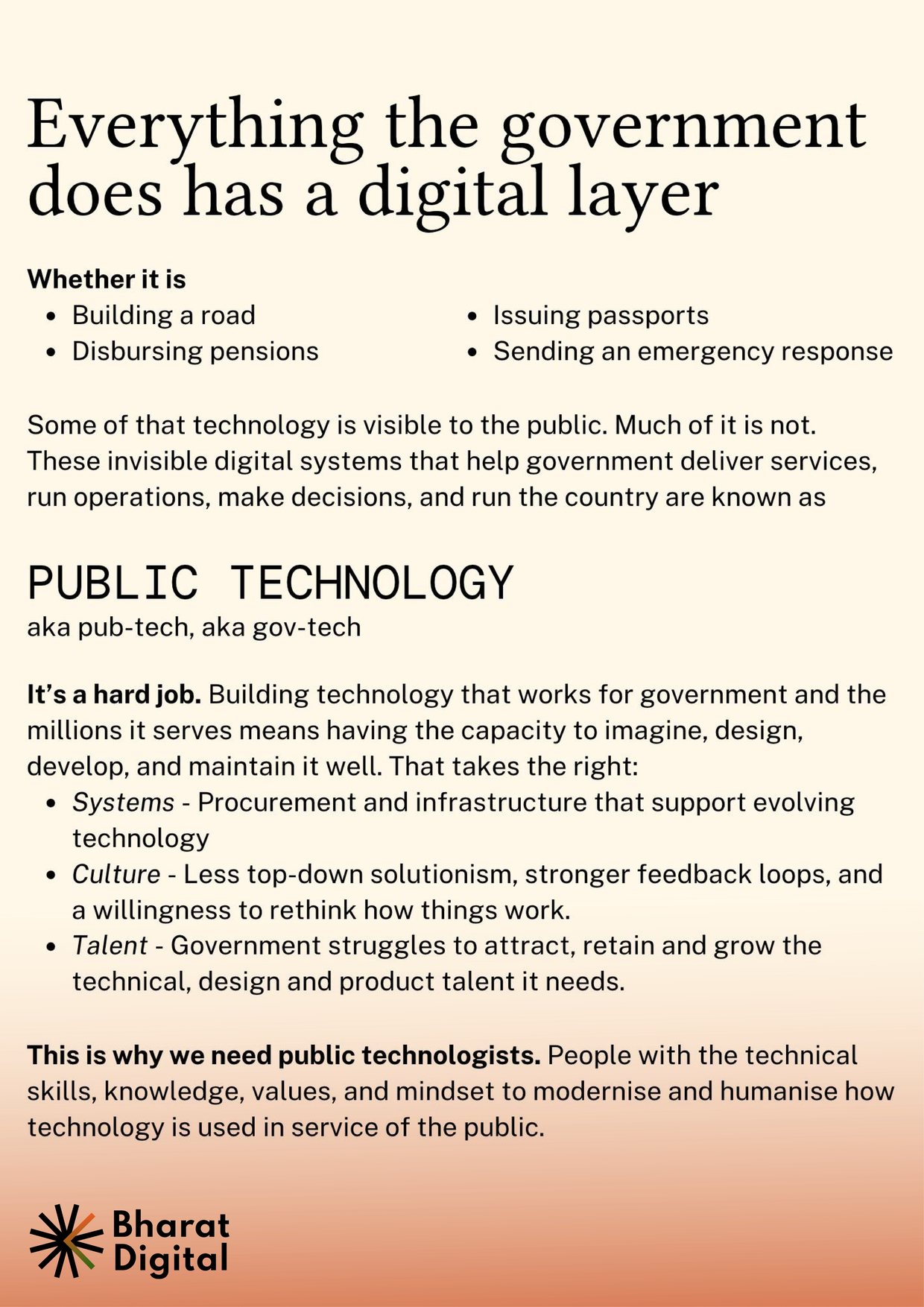
About 12,000 results (thought for 2.45 seconds). We’re a non-governmental organisation, but we help build better technology for governments. We run a fellowship to nurture public technologists, we train government officials, we fix legacy code, and incubate new ideas that reimagine how technology can be used in service of the public. Gosh, all of it was so cool, I remember thinking, as I ran through the list in my mind knowing I was about to lose the question asker’s attention. I mean I was competing with a screen to my right showing a colourful world with cars stacking up at a broken toll booth. A world we made… to break (more on that later).
“We’re Bharat Digital, an NGO that works to modernise and humanise public technology in India, make government technology suck less,” I answer. I vary that response a couple hundred times in the next two days to an assortment of nods, chuckles, and nose exhales.
IndiaFOSS, organised by FOSS United brings together people working with and interested in free and open-source software. The festival draws seasoned developers, passionate students, and talented hobbyists from across the country. And here I was, a journalist who had had her heart broken by journalism, at a tech conference now on a bid to do Something (with a capital S) that mattered. To be honest, I was prepared to deal with tech-bros (offensive) and over-enthu cutlets (inoffensive). If anything, we’d soft launch our “Introduction to Public Technology” piece (the toll booth, remember?) and I’d take my new role out for a spin. I expected techno-utopian-AI-will-fix-everything spiel and figured as long as I wasn’t trying to share the link to our project as https://localhost:5173, I’d be okay.
Turns out, I was so wrong.
IndiaFOSS was a gathering of people who care deeply about how technology is made, who gets to make it, and what happens when it is shared. While there were dedicated pockets for technical learning, the undercurrent was surprisingly philosophical.
Kailash Nadh, CTO of Zerodha, and somewhat of a celebrity at this conference (seemingly to his chagrin) observed in a panel that the questions this year were increasingly existential. As he put it, around 80% of the conversations this year had been about existential angst. Not whether AI would take our jobs, but what the point of learning a skill was, or what the point of anything was. Now that was a sentiment I could relate to! Had I found my people?
It was an interesting place to begin thinking about public technology. Because while the tools and technologies keep changing, the question of who builds the systems we rely on, who maintains them, and who gets to shape them remains very human.
I’ve spent roughly the lifespan of a fruit fly since then, ruminating on the conversations, marinating in the experience, and deciding to share the inner workings of my mind and the outer workings of my organisation.
Bystander or builder?
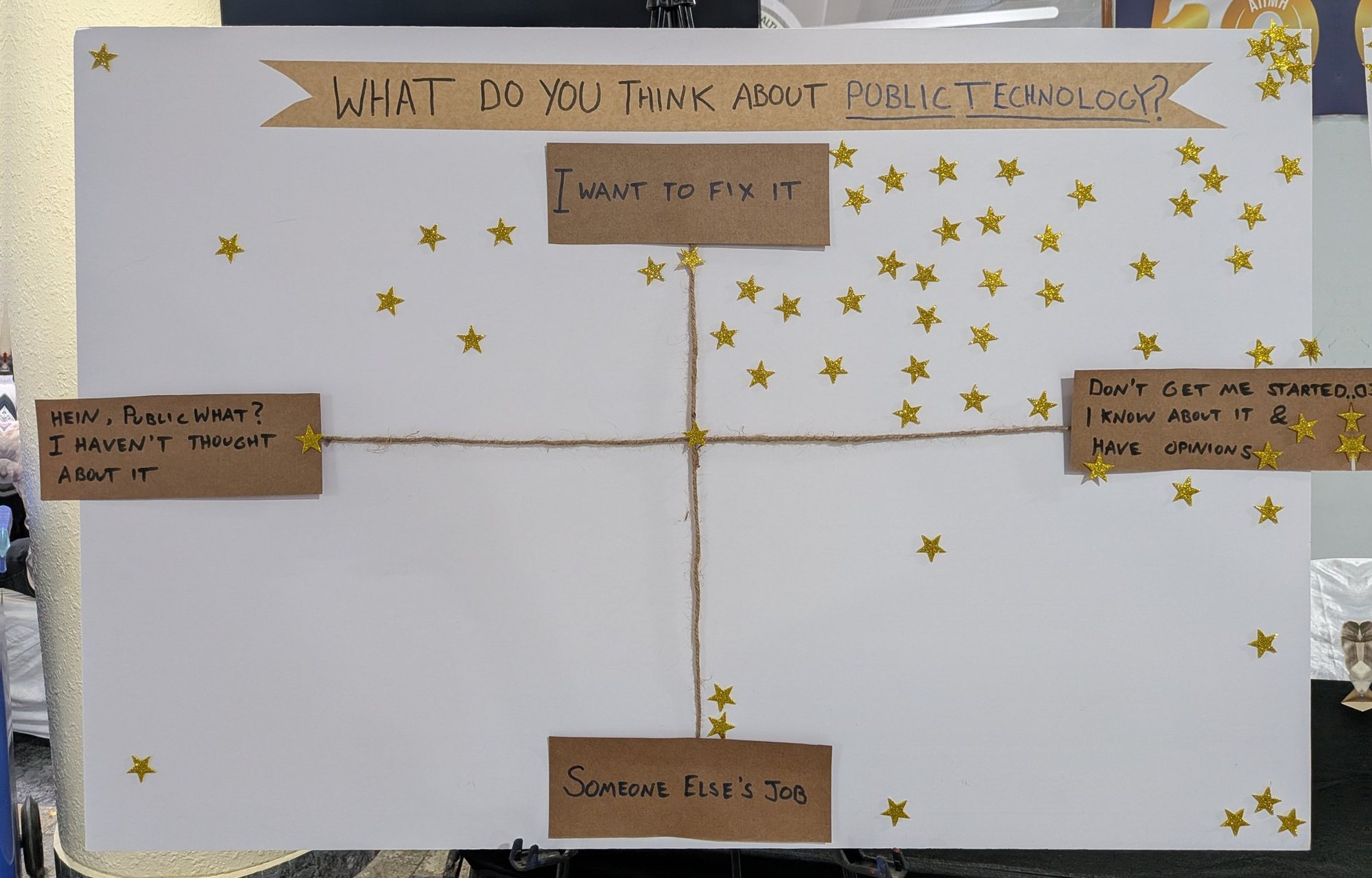
On the first day at the Bharat Digital booth, we wanted to get a sense of how people thought about public technology. Where did they stand? We put up two axes, one about people’s knowledge about public technology and the other on their willingness to get involved. It invited visitors to place a gold star in their quadrant of choice.
Not perfect spectrums, or a scientific method, but enough for me to entice over 50 passers-by with a gold star and a question.
Care to place your star?
Place your star, then see what constellations IndiaFOSS made.
The exercise was hardly a representative survey. Still, I was struck by how many people housed their star on the top right. Some already worked on government systems, others were curious about the field or had ideas about what could be done better. Sure, putting a star is easier than making a lasting change, but attitude is everything and people weren’t indifferent to government technology, they cared! Enough to have stars falling off the top right corner (and obviously more importantly to ask about our organisation and how they can get involved.)
A sticky situation
Our Day 2 activity was more cathartic. We handed people a sticky note and a pen and asked them how government websites and apps make them feel. Write yours, then see the wall.
What do sarkari websites and apps make you feel?
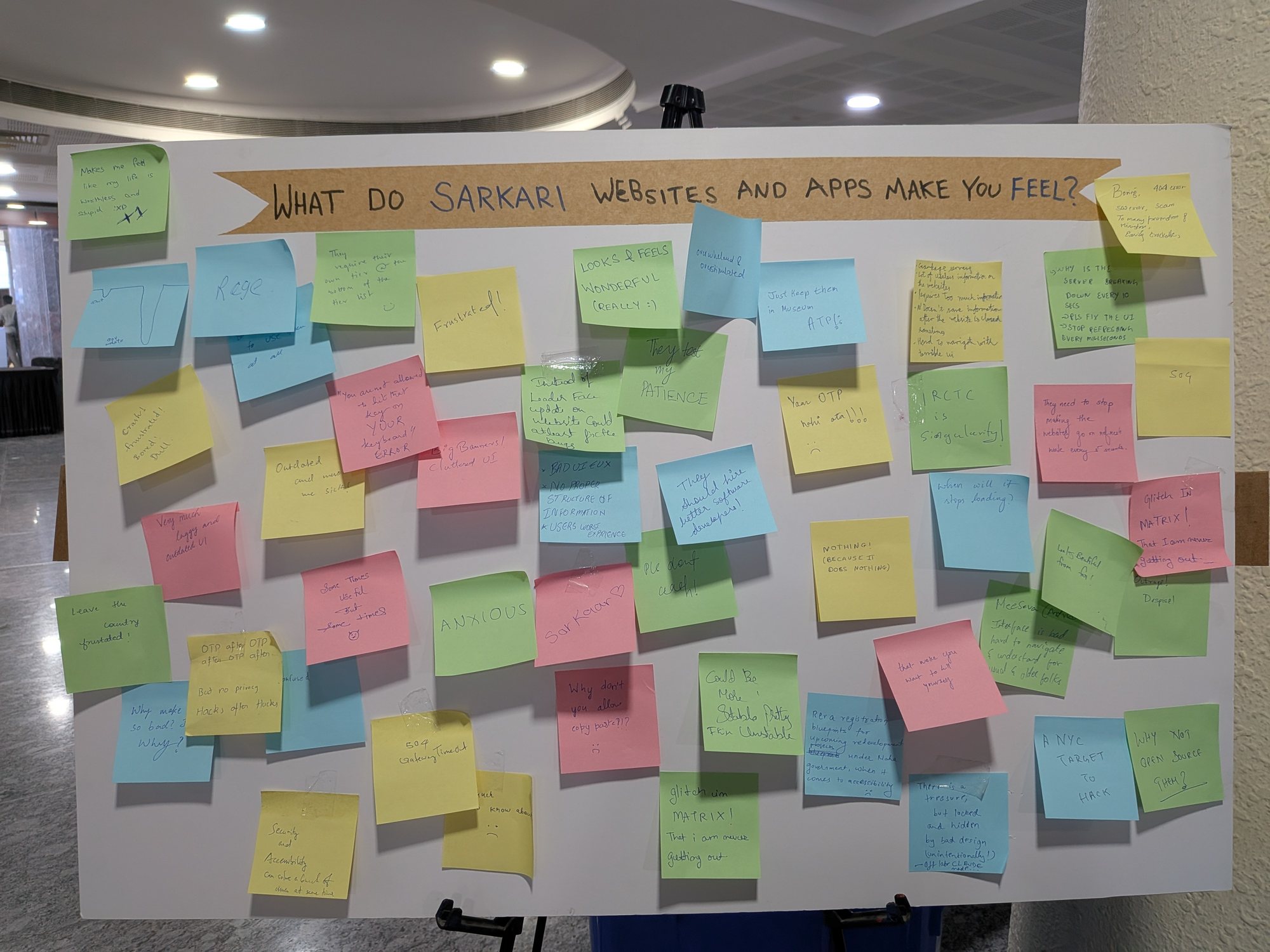
Write a note, or reveal the wall straight away.
There’s plenty to be annoyed about. But, the complaints were familiar. Apart from some damning diagrams and exaggerated dread, the notes were about the OTP that never arrives, the link that leads nowhere, the page that refuses to load, the form that doesn’t want to submit, and an overall UI assault on the senses.
These aren’t exceptional failures, but part of the everyday experience of using government technology. One note simply wrote “504”. I had to look up quite a few error messages and fair enough.
We rarely think about the infrastructure behind the public services we use until something breaks. When it works, it fades into the background. When it doesn’t, we huff and puff but just long enough to find a workaround and get on with our lives. The stakes can be much higher, too. Security vulnerabilities, outdated underlying software, and weak safeguards don’t always announce themselves. A government website can keep functioning even as risks accumulate behind the scenes.
There’s a term for a pattern behind these experiences: normalisation of deviance. It describes how repeated failures can gradually become accepted as ordinary. In everyday use, this might look like refreshing a page several times, switching browsers, asking someone else to try, or keeping a mental list of workarounds. Within organisations, it can mean becoming used to shortcuts, security gaps, or practices that would once have been considered unacceptable. People learn to accommodate a system’s failures.
Over time, expectations shrink. “Sarkari app hai, aur kya ho sakta hai?” as co-founder Harsh Nisar put it. It becomes an explanation for things that should be fixed. In the context of government technology, the range of things people consider acceptable or possible (the Overton window) shrinks. When poor digital experiences become the norm, even imagining a better one can become difficult.
To change what citizens, officials, and technologists consider acceptable, possible, and worth striving for is a wicked problem, but not unsolvable. There were some heartening examples that made my heart grow three sizes.
Scheduled programming
The conference lineup had conversations thinking about public technology across versions. Some were looking at how to explore archives of the past, others were assessing what works and what doesn’t in the present, and others yet were imagining where we could and should go next.
Four sessions. Pick one above.
Pull up a chair
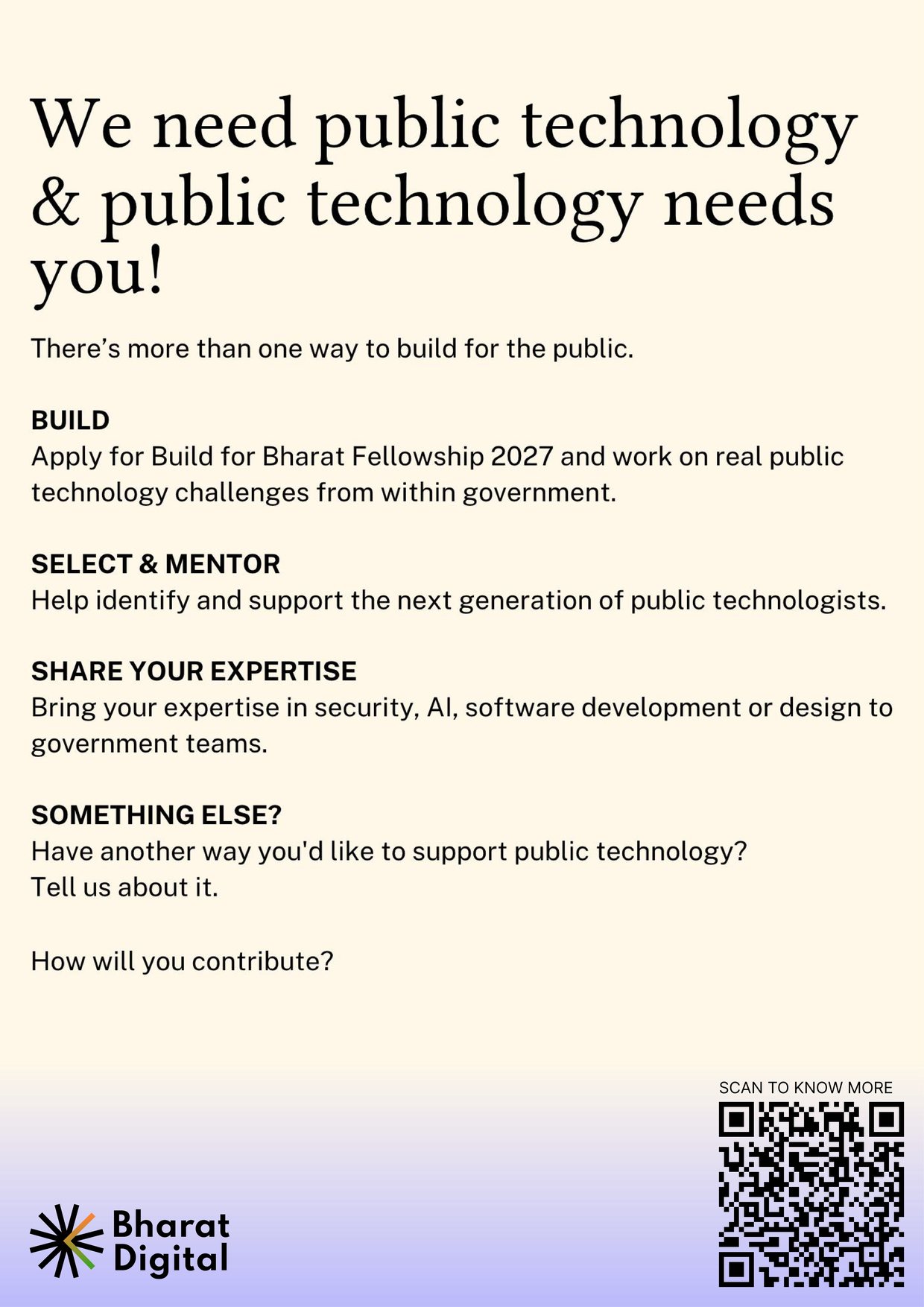
On the heels of IndiaFOSS, we organised a mixer for fellows from the 2025 and 2026 cohorts of the Build for Bharat Fellowship (BFBF).
The idea was to get people who had worked on government projects in different departments and states into the same room. They could meet, catch up, compare experiences, and help us make decisions to better the next cohort.
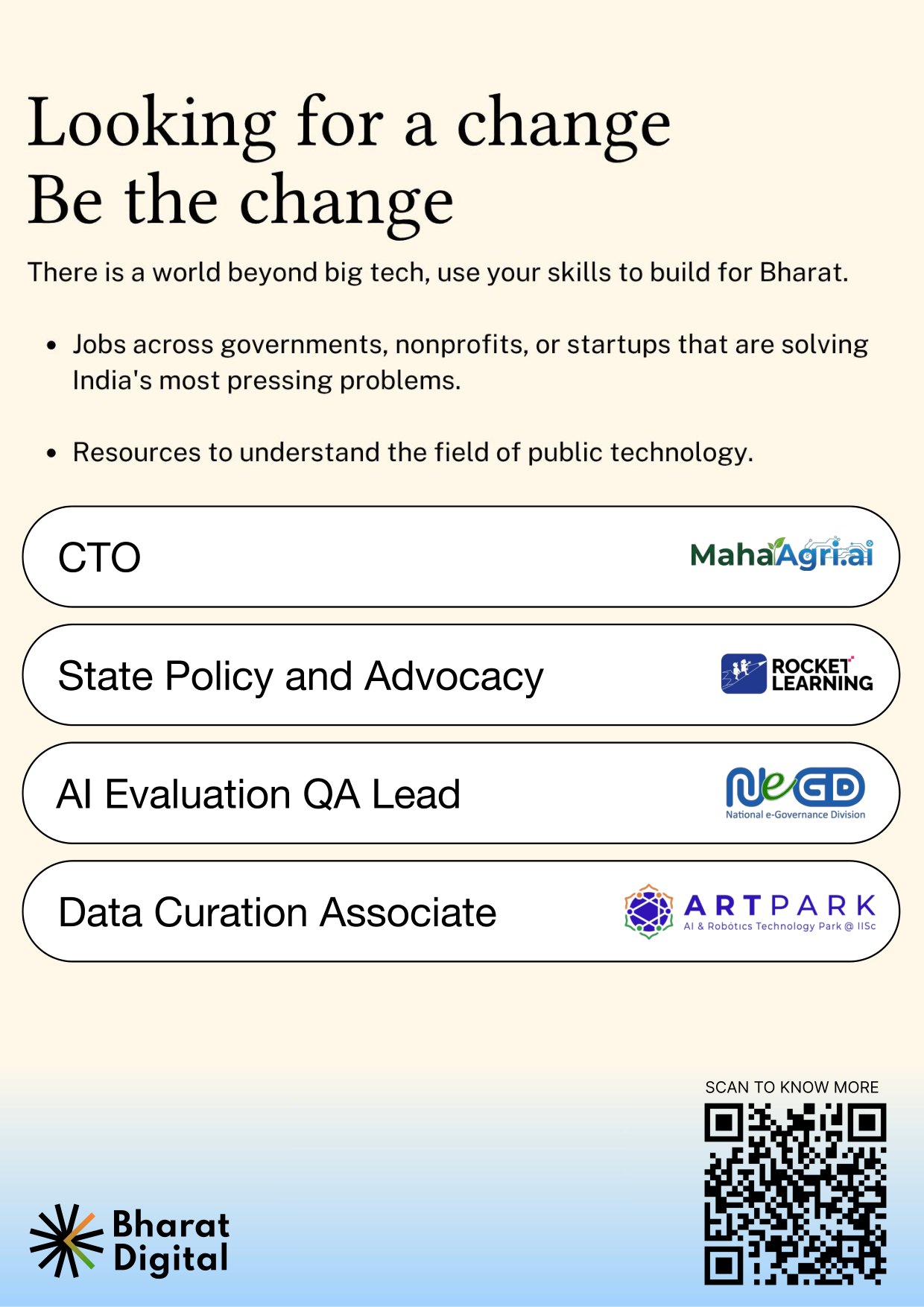
In a nihilistic world, caring and trying to change things can be isolating, but it doesn’t have to be. While we have a phenomenal track record of more than 80% of our last cohort now working in government or choosing to stay in the wider public technology sector, we don’t hold it against those we’ve lost to the corporate side. Wanting better public technology and a community to discuss it with is worth doing, even when it isn’t your day job.
Having found the love of my life (data, and my husband) through a fellowship some 8 odd years ago, I’m so excited to see the BFBF alumni make their way in the world. And their unique stories are helping me make mine in this field.
We hope to make more such meetings happen.

Hoping for, and working towards better public technology
Remember my toll booth? That is a small part of a larger story we’ve been working on to explain what public technology is. It is an attempt to make the sprawling, often invisible field a little easier to understand: how it works, how it breaks, what is at stake, and why it’s so hard. We’ll release it soon!
I think there’s a specific reason my job designation, that-doesn’t-sound-like-a-real-designation, exists at Bharat Digital and why this kind of storytelling matters. Sociologist Susan Leigh Star wrote about how infrastructure tends to fade into the background when it works. We usually notice it when something breaks. Her idea of infrastructural inversion asks us to turn our attention towards the systems we take for granted: the people, decisions, labour, and institutions that keep them running.
Government technology is full of these stories. The engineers maintaining old systems, the officials trying to make a department’s processes work better, the designer thinking through a service used by thousands, the people who depend on it every day. Their work rarely makes it into public conversation.
Author Kurt Vonnegut once wrote, “Another flaw in the human character is that everybody wants to build and nobody wants to do maintenance.” It’s a line I keep coming back to.
Public technology needs people who will build, but it also needs people who will maintain, document, question, and improve what already exists. That work deserves attention too and recently it’s become my job to care and get others to!
If you know me, you know I am constantly oscillating between two fire related songs: “Jala do isse phuk daalo, ye duniya... Tumhari hai tum hee sambhalo ye duniya.” to “We didn’t start the fire, it was always burning since the world was turning.” But whether I want to metaphorically burn it all to the ground or shirk anything to do with the flames, I’ve rarely ever been blazing with hope. Until now.
The problems have always felt too large, too entrenched, and too immovable. Hope is not always my first response. But at IndiaFOSS, I met people who were putting in the work. People building tools, fixing systems, sharing knowledge, asking uncomfortable questions, and making space for others to contribute. The booth activities showed me that people do want to be part of this conversation, even if it’s a subset of a subset. The talks and the mixer gave us a glimpse of the people already having it.
I came to IndiaFOSS wondering what we do. I left with a better sense of what I could do.
The next time someone asks me “What do you do?”, I can confidently answer, “I dare to care,” but that would probably be weird so maybe not. You get the point.
Prakriti Bakshi is the Storytelling & Community Lead at Bharat Digital.
Do you dare to care?